Armoglaze focuses on durable, odorless epoxy coatings mainly used for reglazing bathtubs, showers, sinks, and tiles. Our product offers these surfaces a high-gloss, waterproof, and long-lasting finish.
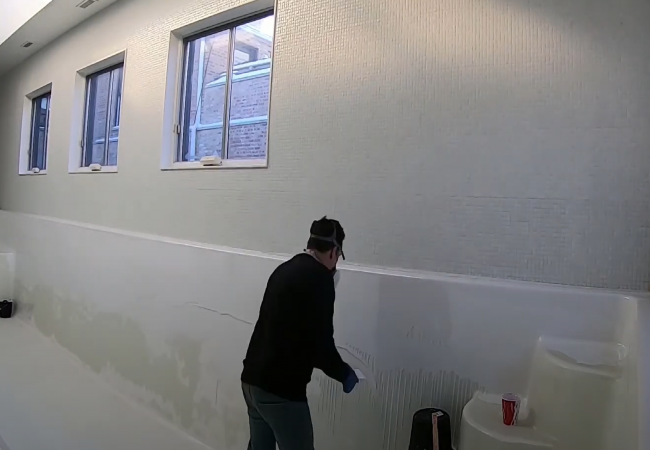
Recently, we undertook an interesting project: applying our coating to a swimming pool. Our video provides more details.
Why Did We Do This?
We do not typically use Armoglaze products for large-scale swimming pool refinishing due to the unique challenges these environments pose, such as continuous water exposure, pool chemicals like chlorine, and strong UV rays, which differ significantly from conditions in a bathtub or shower. We decided to test how our Armoglaze epoxy coating would hold up with this type of surface preparation and application. Our process for refinishing this particular pool surface was similar to our standard bathtub reglazing, with the main difference being the size of the area we worked on.
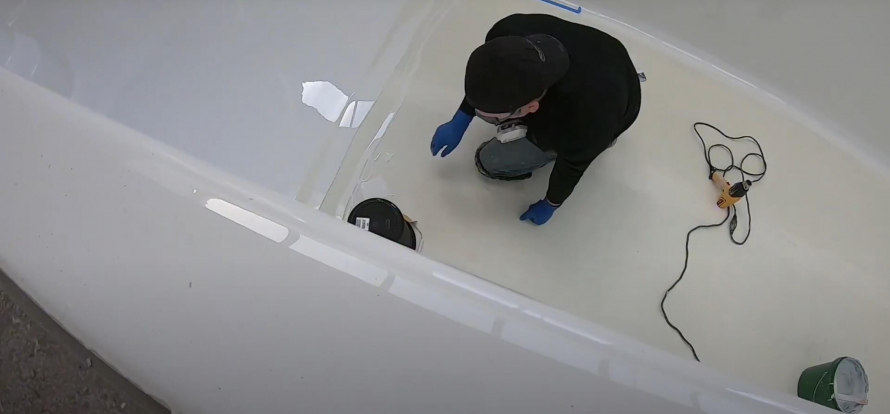
Armoglaze Application for this kind of surface:
- Prepare the surface
- Divide the swimming pool surface into parts
- Divide the product into its parts
- Mix the product in individual batches for each part
- Start applying the Armoglaze epoxy coating using the pour-on method from the top
- Spread the product along the divided parts of the walls
- Then add more product in the middle of the walls, making sure the whole wall is covered to the bottom part of the pool
- Repeat this step for three more walls
- Wait one day for the curing process for the entire wall
- The next day, repeat this process for the bottom part of the swimming pool.
- Wait one more day for the curing.
Draining & Drying: The pool area was completely drained and allowed to dry thoroughly.
Surface Preparation: This involved thorough cleaning and, if needed, etching, similar to preparing a plaster swimming pool. We also repaired small cracks or chips to ensure the surface was smooth and ready for bonding.
This process evens out the surface, resulting in a smooth, uniform finish. A major benefit is that Armoglaze has no odor during application.
Curing: The coating was fully cured per specifications before refilling.
Swimming pool refinishing with Armoglaze. Cost considerations and its intended use.
Our experiment demonstrated the process, but it did not alter the usual costs associated with traditional pool refinishing methods.
You may wonder why dividing the large pool surface into smaller sections was necessary.
This approach relates to a key feature of epoxy coatings called 'pot life.'
Pot life refers to the working time after mixing epoxy's two components: Part A resin and Part B hardener.
When mixed, a chemical reaction occurs, causing the mixture to gradually thicken and harden.
A single batch offers ample working time for a small project like a bathtub. However, coating an entire pool takes longer due to its size.
Mixing all the Armoglaze at once could cause the epoxy to harden before application, making it unusable.
To prevent this, we divided the pool into sections and prepared smaller batches for each, ensuring fresh epoxy within its usable period. This is key for achieving a smooth, even finish on large surfaces.
The cost of pool refinishing depends on:
- pool size
- project duration
- material costs
The application shown in the video was an impressive example of the work.
For in-ground pool repairs, hiring professionals is recommended. They possess the proper materials, designed for underwater use, and include warranties.